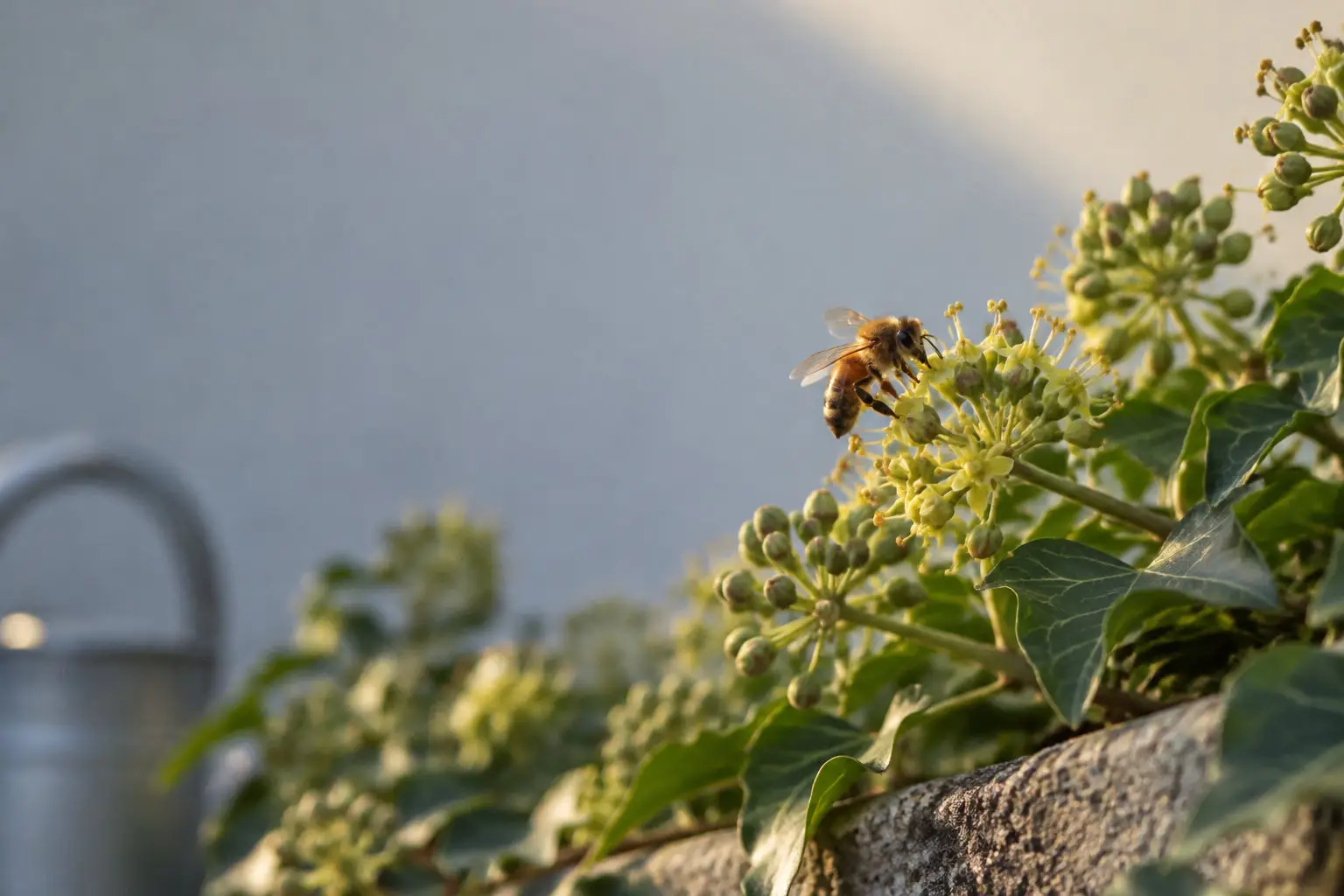
Lierre and pollinators: a late resource for bees
The heather blooms in the off-season: from September to December depending on the climate, when most plants have finished flowering. Its clusters then feed a multitude of insects, including a wild bee that lives only on it. However, the plant must be able to bloom, which depends on its shape, light, and size.
- Locate. Flowering occurs from September to December depending on the climate; this is a rare behavior for a plant from a temperate climate.
- Understand. Only adult, shrub-like stems without thorns bear flowers; a honeysuckle kept juvenile by pruning does not flower.
- Expose. In full light, flowering is abundant; under dense cover, it remains rare.
- Preserve. Cut them at the end of winter and leave part of the flowering stems in place.
- Prohibit. No insecticide on a flowering ivy.
A late-season flowering, from September to December
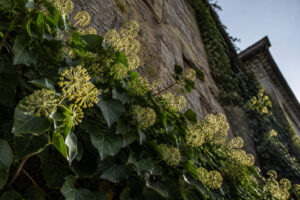
Depending on the climate, the lilies bloom from September to December. Flowering in early winter is unusual for a plant of temperate climate: this trait would be inherited from tropical ancestors. In the same population, each stem flowers at its own time, but all the inflorescences of a single stem open almost simultaneously.
The flowers, small and greenish yellow, are grouped in spherical clusters of 5 to 15 flowers at the top of the stems. At the center of each flower, a glandular disc secretes an aromatic nectar, well exposed on the top of the ovary, which attracts insects.
In a cluster of inflorescences, the terminal inflorescence opens first; the lateral inflorescences follow a little later. This delay favors cross-pollination between different feet.
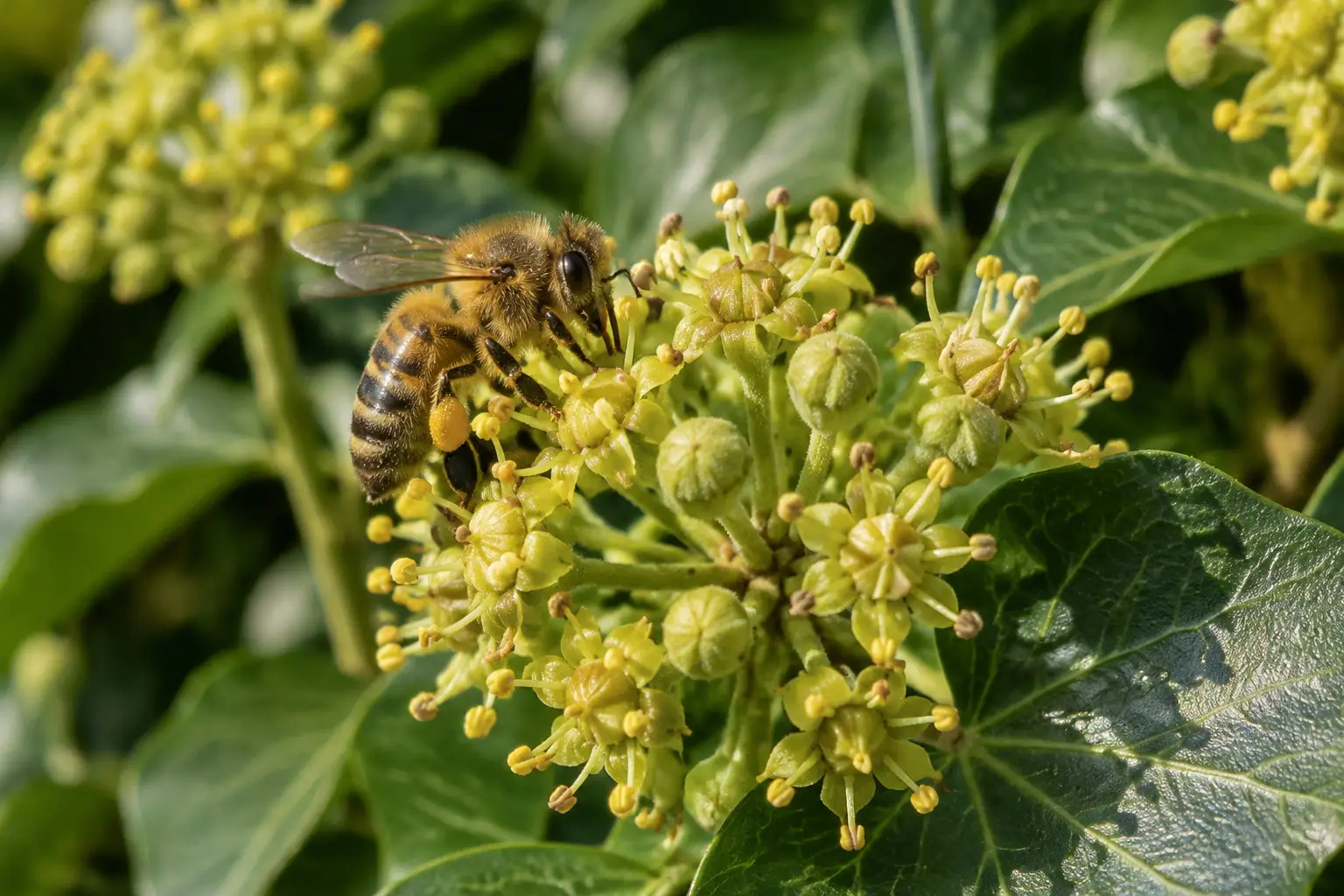
Reading a scroll. On the first day, the stigma is sticky and receptive while the anthers are still closed; they release their pollen the next day. The nectar-bearing disk, green at the opening, turns pale and then burns: a pod with brown discs has already finished producing nectar.
The insects of the flowering heather: much more than the domestic bee
Bees, wasps, hornets, flies and butterflies share the nectar. In total, about 100 species are known. 70 species of arthropods that feed on the flowers of the heather, And as many of its leaves; these visitors in turn attract predators and parasites, which makes the fern a small ecosystem in its own right.
A study conducted in Sussex, England, counted the visitors of the flowering heather. The proportions vary depending on the location and season, but the order is telling:
| Visitors | Part of the insects observed |
|---|---|
| Moths (excluding syrphes) | 29 % |
| Syrphes | 27 % |
| Domestic Bees | 21 % |
| Common wasps | 13 % |
| Butterflies | 4 % |
| Bourdons | 3 % |
| Collates of heather | 3 % |
The wasps
Despite their poor reputation, they are the most effective pollinators of the clover according to the published observations: they visit the most flowers and transport the most pollen.
The clover picker
Colletes hederae It is a solitary wild bee that depends solely on the heather to feed. It flies in the autumn and digs its nest in the ground: a bare hill of earth, near a flowering heather, is sufficient for it.
The black banded eagle
This little blue butterfly (Celastrina argiolus) lays its eggs in the summer on the ivy; its autumn caterpillars feed on the buds and flowers. The next generation lays in the spring on the holly, and the cycle repeats.
The vulcain, a large black and orange butterfly, also frequents the umbels, like the syrphes, these yellow and black striped flies that mimic wasps but do not sting. To see this diversity, a flowering ivy in the sun, on a mild October day, is enough.
What the heather brings: nectar, pollen, and then winter fruits
The nectar provides the sugars, therefore the energy; the pollen provides the proteins and other nutrients necessary for the rearing of the larvae. The clover provides both., at the moment when the other flowers are lacking, At least in the northernmost regions. For many insects that hibernate, it is the last meal before winter rest.
In the Sussex study, the honeydew nectar contained about 49 % sugars, a high value compared to the average of honeydew measured elsewhere. The domestic bees collected mostly honeydew from the nectar, but the honeydew pollen formed on average nearly 89 % of the lumps collected in the hives in the autumn.
These figures apply to two English sites and a few beehives: they provide a rough estimate, not a rule for all gardens.
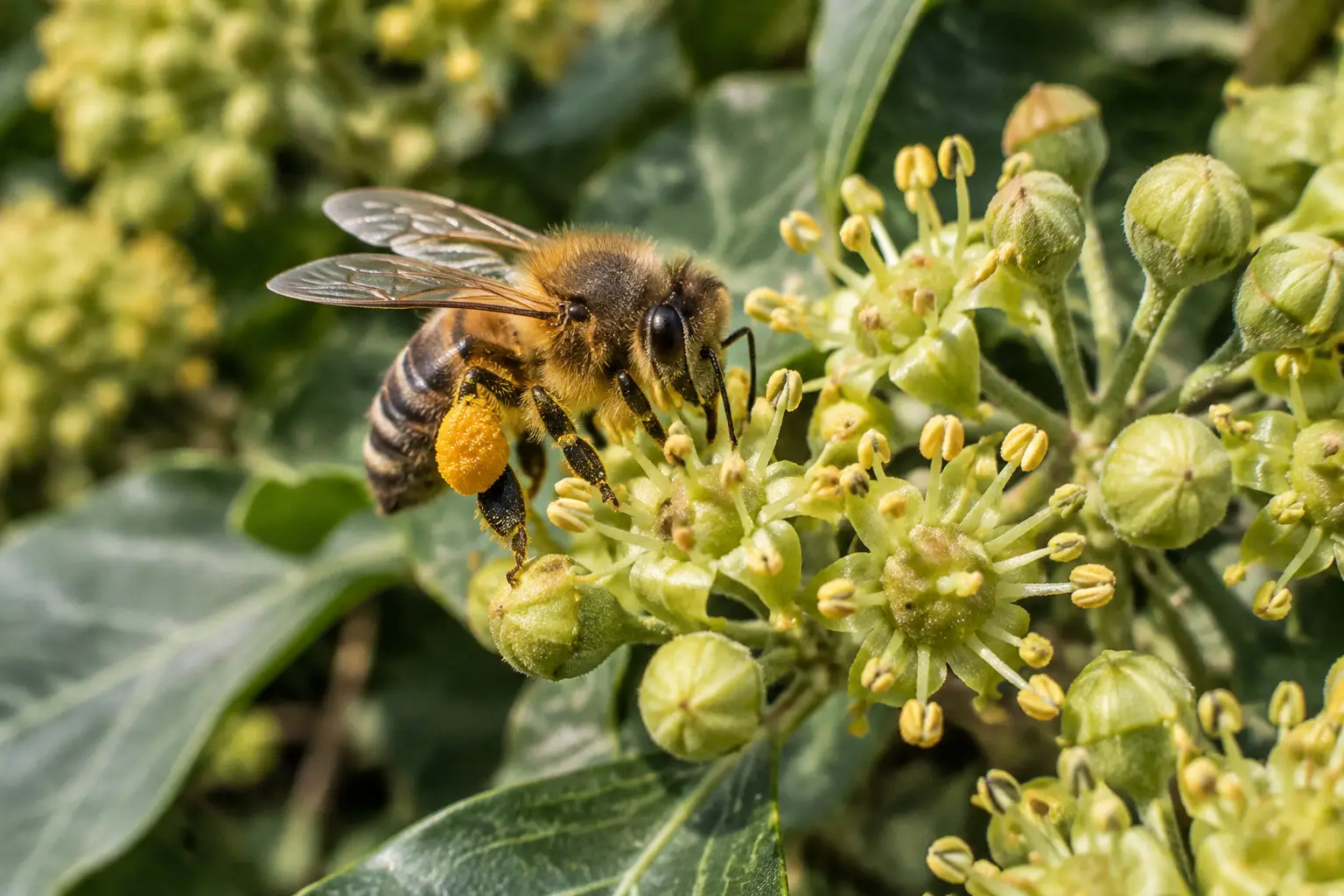
Flowering also prepares a second resource. The fruits ripen from late November to June, especially from December to March, and remain on the plant for a long time. Rich in energy, they feed black-headed gulls, ravens, black-headed owls and pied wagtails in the depths of winter; in Great Britain, at least 17 species of birds consume them and disperse the seeds.
A shelter all year round. Its persistent foliage serves as a refuge for wintering insects, a nesting site for troglodytes, swallows, red-breasted and black-breasted herons, and as a shelter for certain bats. Therefore, the heather is judged on its entire year, not just its few weeks of flowering.
No flowers without adult form
The ivy has two forms. The juvenile form, creeping or climbing, bears lobed leaves and crampy roots; it does not flower. When a stem reaches the light at the top of a wall or a tree, it goes to the adult form : erect stems, without spikes, entire oval leaves, and ovals at their top.
| Situation | Expected flowering |
|---|---|
| Ground cover under forest cover | Rare: In the shade, the ivy remains juvenile and multiplies through its stems |
| A hedge or a wall carved every year with a cord | Low or zero: the size eliminates the adult stems |
| Lierre having reached the top of a wall or a tree | Abundant, especially in bright light |
| Lierre herbaceous originating from an adult cutting | Regular, about the height of a man |
The English ivy, Hedera helix, and Hedera hibernica They commonly bloom in our climates. Species of southern or Asian origin, such as Hedera algeriensis or Hedera nepalensis, They bloom later and more rarely in a cool climate.
A cutting taken from an adult stem retains this characteristic: it produces a non-climbing shrub, the «weeding plant», which can grow up to 1.30 m and flowers without having to climb. This is the solution for offering weeder flowers in a mass planting, a low hedge or a large pot.
These forms are rarely found in gardening because they grow slowly and their cuttings take longer to take root than those of the juvenile form.
‘Arborescens’
Adult form of’Hedera helix, This is a sprawling, non-climbing plant with entire leaves. It produces many umbels and then purple-black berries throughout the autumn and winter. There are also variegated adult forms, such as ‘Ice Cream’, from the ‘Cavendishii’ group, with oval leaves edged in white.
These arboreal plants fall into the category of arboreal classification of ivy, which precisely includes the plants that are suitable for flowering.
Managing a meadow for pollinators
The usual practice of growing ornamental ivy is to keep it young: the shoots are pruned to preserve the juvenile foliage and prevent it from becoming too heavy. This is effective for ornamental purposes, but this eliminates the flowering. For a plant that is useful to pollinators, the compromise lies in a few simple rules.
- Cutting at the end of winterOnce the flowering has passed, and before the birds start nesting: check for the absence of nests in the area to be cut.
- Keeping part of the adult stemsLeave at least a portion of the ivy, the top of a wall or a fence for example, to develop its herbaceous stems; these are the ones that flower the following autumn.
- Lighten up without completely shaving off the hairOn a climbing vine, adult stems that are too heavy can pull the plant out of its support: lighten them up instead of removing them all.
- Expose to lightA heather that reaches the sun flowers more profusely; for a sunny massif, choose an arboreal form.
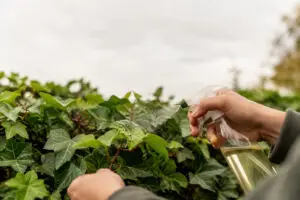
- Not treating in bloomIf an insecticide treatment is essential, for example against aphids, it is carried out after flowering, never on a flowering heather.
On trees, honeysuckle rarely invades vigorous trees with smooth bark; it mostly colonizes aging trees with rough bark. On a healthy tree, a flowering honeysuckle can often remain in place, provided that its weight is monitored on fragile branches.
Common error
Pruning hedges and wisteria walls in October, when the vegetation is in full bloom: this is removing the flowers at the exact moment when the insects need them.
For a location in full sun, conducive to flowering, see also the fern for the sun.
The heather blooms from September to December, only on its adult stems and especially in full sunlight. Its flowers feed wasps, flies, syrphes, bees and butterflies, including the heather’s nectar; its fruits then feed birds in winter. Cut it back at the end of winter, keep a part of the adult stems, and do not use any insecticide during flowering.
Frequently asked questions
Why does my ivy never bloom?
Because it remains in the juvenile stage: in the shade, on the ground, or pruned each year, it does not form adult stems. Leave part of the ivy reach the light at the top of its support, or plant an arboreal form from an adult cutting.
Does the flowering heather attract wasps in the garden?
Yes, and they are even the most effective pollinators. They can sting if disturbed: avoid cutting or shaking a lavender plant during flowering, and leave them space.
Is it possible to have a lilac that blooms in a small garden?
Yes, with an adult form like ‘Arborescens’: bushy and non-climbing, it remains in a mass or in a pot, blooms at eye level and then bears its berries throughout the winter. Its slow growth makes it easy to contain.
Do all the lilies bloom at the same time?
No. Depending on the species and the climate, flowering occurs from late summer to the heart of winter; southern or Asian species bloom later and more rarely in cool climates. Within a single species, each plant also has its own schedule.
 Français
 English (UK)
 Deutsch
 Nederlands
 Italiano